

Written By: Adam Wick, LPCC, LADC, CSAT | Founder of Vital Mental Health, Roseville MN
Mother-son enmeshment doesn’t look like abuse. It doesn’t leave bruises or give you something concrete to point to.
It’s quieter than that. You feel like a guest in your own relationship. His mother’s moods carry more weight than yours. You try to get closer and he drifts further away, and somewhere along the way you’ve started wondering if the problem is you.
It isn’t.
What you’re navigating has a name. It’s rooted in his history, not your inadequacy. And it’s one of the more complex things a couple can face. Not because it’s hopeless, but because the roots run deep and most people don’t recognize it until they’ve been living inside it for years.
This guide is written for you: the partner on the outside of that dynamic, trying to make sense of what’s happening and figure out if there’s a way through.
What Is Mother-Son Enmeshment?
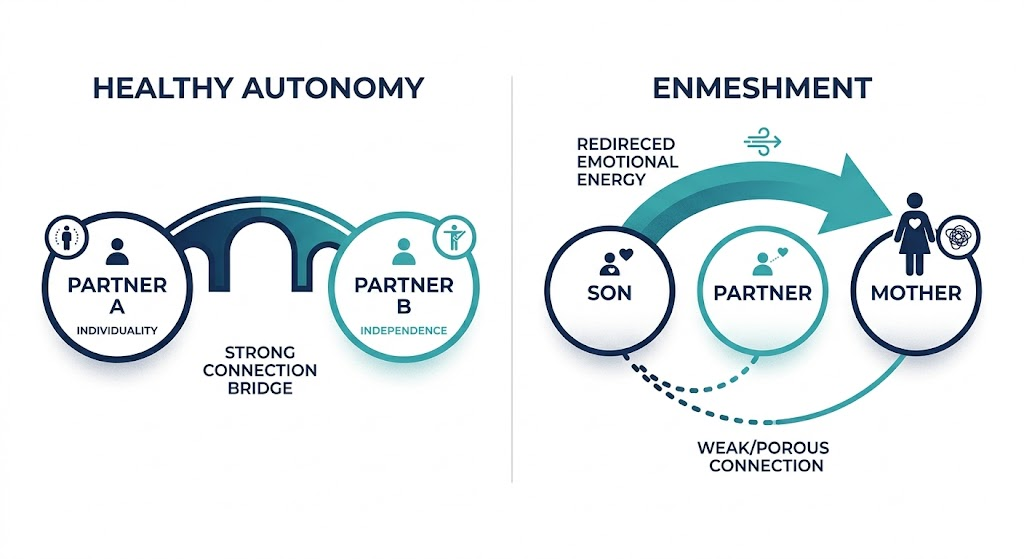
Mother-son enmeshment is a form of emotional over-involvement in which the boundary between a mother and her adult son becomes so blurred that his sense of identity, emotional life, and relational capacity are shaped primarily around meeting her needs rather than his own.
Unlike healthy closeness, which allows for warmth and support while still encouraging each person’s independence, enmeshment creates a kind of emotional fusion. His mother isn’t someone he loves and also lives his own life apart from. She’s, in a deep and often unconscious way, the primary attachment figure he continues to organize his life around.
The concept was first introduced by family therapist Salvador Minuchin in the 1970s to describe families where personal boundaries dissolve at the cost of individual autonomy. In the decades since, clinicians working at the intersection of family systems and addiction have built out a much more specific picture of how this plays out between mothers and sons.
This dynamic usually develops out of unmet maternal need, not malice. The mother, often dealing with loneliness, marital unhappiness, or her own unresolved history, turns to her son to fill an emotional role that belongs to a partner or adult peer. She may confide adult problems to him. Lean on him for reassurance. Treat his independence as rejection and his relationships as competition.
The son learns early that his job is to manage her emotional world. His needs become secondary. Love means compliance. Separating, in any real way, comes with a cost he can’t always afford.
As Dr. Ken Adams, a psychologist and internationally recognized expert in trauma-induced intimacy disorders, describes it: the enmeshed man lives in two realities at once. The adult world where he’s expected to function independently, and an inner world still organized around his mother’s emotional state.
That’s the world your partner is operating from. Until he starts to see it, it shapes everything between you.
Signs of Mother-Son Enmeshment in Adult Relationships
Men in this dynamic don’t usually describe it that way. They don’t say, “I have an inappropriate emotional relationship with my mom.” They say things like “She needs me” or “It’s complicated” or “You just don’t understand our family.”
What you notice is the behavioral pattern it produces. Here’s what it tends to look like from a partner’s side:
Emotional and relational signs:
- Emotional withdrawal: he goes flat, and intimacy feels like a risk he avoids
- Difficulty being present, especially after contact with his mother
- Decisions deferred to what she would want, even when she’s not in the room
- Passivity with both her and you, conflict avoidance as a survival strategy
- Dismissing your concerns about her: “She means well” or “That’s just how she is”
- Chronic low-level guilt that seems sourceless, because existing separately from her feels like betrayal
Boundary and loyalty signs:
- She’s involved in decisions that belong to the two of you
- He shares things about your relationship that feel private
- Plans get cancelled to meet her emotional needs, without a conversation with you first
- He defends her behavior in ways he’d never defend yours
- Calls or visits leave him anxious, irritable, or somewhere else entirely
Behavioral patterns worth noting:
- Avoidance of real intimacy, sometimes filled by pornography, fantasy, or emotional numbing. Compulsive sexual behavior and enmeshment frequently co-occur, and the wound underneath is often the same
- Passivity that makes it genuinely hard to resolve anything between you
- Resentment that seems to come from nowhere, as though what belongs to her gets redirected at you
If several of these feel familiar: you’re not overreacting. You’re reading something real.
How This Shapes Your Relationship and You
Being in this situation produces a particular kind of tired. Not the tired of working too hard. The tired of never quite landing. Of expressing a need and watching him shut down or look at you like you’re asking for too much.
Over time it erodes self-trust. You start wondering if you’re the problem: too needy, too emotional, too much. Some partners start shrinking their needs preemptively, trying to make themselves easier to be with.
That shrinking is a signal, not a solution.
What you’re experiencing isn’t a standard relationship problem. It’s the relational fallout of a developmental pattern that was in place long before you arrived. The enmeshment shaped him before he ever met you.
Understanding that doesn’t make the pain disappear. But it does take “What’s wrong with me?” off the table, which is where it belongs.
What You Can Do: A Partner’s Roadmap
This section is practical. It’s for the version of you who has already done a lot of feeling confused and hurt, and is ready to think about what actually moves things.
1. Understand the system he came from
You’re not dealing with a habit he could break if he tried harder. You’re dealing with the emotional architecture of his family.
In enmeshed family systems:
- Her emotional needs become the organizing priority of the household
- He becomes her primary emotional regulator, responsible for her moods, her comfort, her security
- Healthy separation gets treated as betrayal, not maturity
- The internal boundaries that allow a child to become his own person were either never built or actively knocked down
That system taught him that love means compliance. That attachment theory can help explain: when a child’s primary bond becomes organized around managing a parent’s distress rather than developing his own security, he builds a relational template he carries into every adult relationship. He doesn’t arrive in your life as a blank slate. He arrives with a nervous system already wired to a different loyalty system.
Understanding this doesn’t mean excusing what hurts you. It means you stop taking it as a verdict on your worth.
If it helps to go deeper: Dr. Ken Adams’ book When He’s Married to Mom is still one of the most thorough explorations of this dynamic written for both the men who live it and the partners who love them.
2. Talk about it — but pick your moment and your framing
This conversation doesn’t happen well in the middle of a fight, right after something went sideways with his mother, or when either of you is running on empty. It needs room.
When you do approach it: lead with the relationship, not with her. The goal isn’t to convince him his mother is the problem. It’s to help him see that a pattern between the two of you is causing real damage, and that you want to work on it together.
Something like:
“I’ve been thinking about some patterns between us. I want to talk about them, not to blame anyone, but because I love you and I want us to work. Can we find time this week?”
Once you’re in it, stay in your experience:
“When decisions get made around what your mom needs before we’ve talked, I don’t feel like a real partner. That’s what I want to change.”
Don’t use the word “enmeshment” early. It reads as a diagnosis and will shut the conversation down. Keep the focus on what’s happening between you. The clinical language can come later, usually with a therapist in the room.
3. Encourage therapy — and be specific about what kind
He won’t work through this on his own. Enmeshment is protected by a loyalty system that runs below conscious thought. Insight alone rarely moves it. He needs a therapist who understands developmental trauma, attachment wounds, and family systems. Not just someone who’s “good at relationships.”
When you bring it up, specifics help:
- Individual therapy for him, with a trauma-informed clinician trained in attachment and family systems work. That’s where he gets to examine the loyalty contracts he’s been running under, separate from you and separate from her.
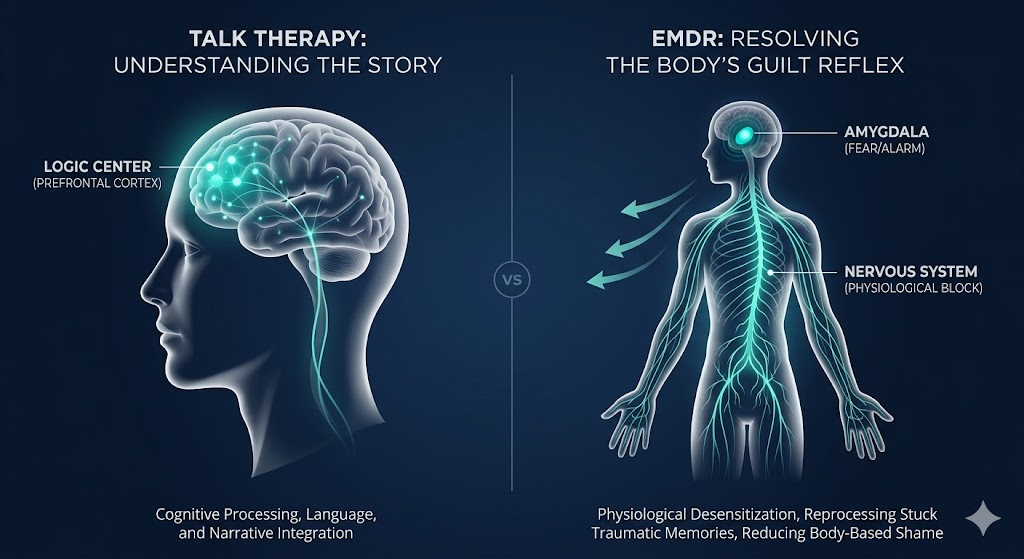
- EMDR is worth knowing about specifically if the effects of his upbringing show up at a body level: the guilt response when she’s disappointed, the anxiety when she calls, the way her distress becomes his emergency. EMDR doesn’t just address the story of what happened; it works on the physiological imprint the story left. It’s endorsed as a first-line trauma treatment by the WHO, APA, and the U.S. Department of Veterans Affairs. Learn how EMDR for attachment trauma works at Vital Mental Health →
- Couples therapy isn’t about litigating his relationship with his mother. It’s about addressing what that relationship has done to yours: the distance, the communication breakdown, the patterns neither of you have the tools to change yet. Explore couples therapy for enmeshment at Vital Mental Health →
Credentials matter. Look for someone trained in family systems therapy, attachment-based approaches, or relational trauma. If compulsive behaviors are part of the picture (pornography, substance use) a CSAT (Certified Sex Addiction Therapist) is trained to work at the intersection of those behaviors and the relational trauma underneath them.
Not sure where to start? A free 15-minute call with one of our therapists costs nothing and can help you figure out what kind of support actually makes sense. Schedule a discovery call →
4. Hold your boundaries — not as punishment, but as self-protection
Boundaries here aren’t ultimatums. They’re not about forcing a choice between you and his mother. They’re about naming what you will and won’t participate in, clearly and without hostility, and then actually holding that line.
Specific to this dynamic:
- “I’m not comfortable with the details of our relationship being shared with your mother. That needs to stop.”
- “We need to make decisions as a couple before outside opinions come in. That’s not negotiable for me.”
- “When our plans get cancelled to meet her needs without a conversation first, it affects how safe I feel here. That needs to change.”
The key is saying it without heat, and then enforcing it. A boundary without a real consequence isn’t a boundary. It’s a request he’s already decided whether to honor.
One thing to be honest with yourself about: you cannot change his mother. You cannot persuade her that the dynamic is harmful. You cannot logic your way into becoming his priority by being more reasonable or more patient than she is. The work starts with him, with his willingness to look at what he’s been running on.
Your limits protect you while that examination either happens or doesn’t.
5. Get support for yourself — not eventually. Now.
If you’ve been in this dynamic for any length of time, you’ve likely spent enormous energy trying to understand it, adapt to it, and fix it from the outside. The self-doubt you’re carrying, the sense that you’re too much, that you’re never going to be enough, that didn’t come from nowhere.
You need someone in your corner who understands this specific terrain: what it does to a person to be on the receiving end of emotional unavailability over time, and how to find solid ground again.
Individual therapy for yourself, not to learn how to manage him but to take care of yourself through this, is often the most important first move. We also have a dedicated page of support resources for concerned partners if you’re not sure what kind of help fits right now.
Support groups for partners of emotionally unavailable men exist too. There’s something specific that comes from sitting with people who’ve been inside the same thing.
Getting support for yourself often gives you the clarity to understand what you actually want, separate from the dynamic you’ve been surviving.
What Therapy for This Actually Looks Like
Most people don’t know what to expect from therapy for something like this. Here’s what effective work on enmeshment generally looks like in practice.
His individual work starts with psychoeducation: understanding what enmeshment is, where it came from, and how it’s showing up in his behavior now. Not blame. Orientation. From there, the work gets into the loyalty contracts he’s been running: the implicit rules that say her emotions are his responsibility, that his needs come second, that separating is dangerous. A skilled therapist doesn’t try to dismantle those quickly. The loyalty system is shame-protected. The work is slow and deliberate, which is exactly why it tends to hold.
His EMDR work addresses what the loyalty system left behind at a body level: the guilt reflex, the inability to tolerate her disappointment, the way contact with her still registers as threat or obligation. EMDR for attachment trauma reprocesses the experiences that created those patterns. It’s not talk therapy. It works on what the nervous system stored, which is often where talk therapy alone stalls.
Your individual work is separate from his, and it’s not contingent on whether he shows up. It’s about understanding what this dynamic has done to you, rebuilding trust in your own perception, and getting clear on what you need. Partners who’ve been in this situation for a while often discover that their sense of their own needs has quietly shrunk. Therapy is the place to reverse that.
Couples work focuses less on his mother and more on what the dynamic has built between you: the communication patterns, the distance, the cycles that keep repeating. A good couples therapist gives both of you a structure you don’t currently have. It’s not about determining who’s right. It’s about building something neither of you has been able to build alone.
On timeline: this isn’t a short-term fix. Real change in attachment patterns takes months, often six months to a year of consistent work, sometimes longer. But it happens. I’ve seen it. The prognosis for couples who both commit to the work is genuinely good.
When He Resists
He probably will, at least at first. Enmeshment is protected by shame, and shame has good defenses: minimizing, deflecting, turning it back on you, retreating into the same arguments that never resolve.
When that happens:
What doesn’t help: pushing harder, naming his mother as the source of the problem, issuing ultimatums in the middle of conflict, or trying to reason your way through a loyalty system that doesn’t operate on reason.
What does help: staying in your own experience instead of arguing about his, naming the impact on the relationship rather than diagnosing the cause, and holding your limits even when it’s uncomfortable.
What’s true: you can’t make him ready. Readiness to examine a loyalty system this old has to come from him. What you can do is be honest about what you need, hold your line, take care of yourself, and let him see, over time, that the current arrangement has real costs for both of you.
As Dr. Adams writes in When He’s Married to Mom: it’s entirely possible to love your mother and still build a genuine life of your own. Those things aren’t in conflict. But most men don’t get there without help.
Frequently Asked Questions
What’s the difference between a close mother-son relationship and enmeshment?
Healthy closeness allows for warmth and genuine care while still preserving each person’s independence. Enmeshment is different in one specific way: the son’s identity, emotional life, and relational choices are organized primarily around meeting his mother’s needs. In a healthy relationship, both people have room to be separate. In an enmeshed one, his separateness feels like a threat, to her and often to him.
Can mother-son enmeshment be healed in an adult relationship?
Yes, but it requires his active willingness to do the work, usually with professional support. Enmeshment is a learned pattern, not a fixed trait. It changes. I’ve worked with men who’ve made real, lasting shifts. The prognosis depends significantly on whether he’s able to acknowledge what’s happening and commit to actually addressing it, not just acknowledging it.
How do I bring this up without it turning into a fight?
Timing matters. Don’t raise it right after something happened with his mother, or in the middle of a conflict already in progress. When you do bring it up, lead with the relationship, what you’re experiencing between the two of you, rather than with a diagnosis of him or her. “I notice a pattern between us I want to talk about” lands differently than “you’re enmeshed with your mother.” A couples therapist can also create a structured space for this conversation that you don’t have on your own.
How long does this take to change?
There’s no honest universal answer. Meaningful change in attachment patterns usually takes months of consistent work, often six months to a year of individual therapy, sometimes more, sometimes alongside couples work. People notice real shifts before they’re “done.” The first ones tend to be in awareness and in being able to name the pattern. Behavioral change follows, but it takes time to get there.
Does EMDR actually help with this?
Yes, and it can be particularly effective for the parts of enmeshment that live in the body rather than the mind: the guilt reflex, the anxiety that gets triggered when she calls, the way old loyalty patterns activate before he’s even aware of them. EMDR works at the level of the nervous system’s stored responses. It’s used alongside talk-based therapy, not instead of it. It’s also recognized as a first-line trauma treatment by the WHO, APA, and VA/DoD.
What kind of therapist should I look for?
Someone trained in family systems therapy, attachment-based approaches, or developmental trauma. If compulsive behaviors are part of the picture (pornography, substance use, gambling) a CSAT (Certified Sex Addiction Therapist) is specifically trained to work at the intersection of those behaviors and the relational trauma underneath them. For couples work, look for training in RLT (Relational Life Therapy), EFT (Emotionally Focused Therapy), or Gottman Method.
Is it worth me getting my own therapy if he won’t go?
Yes, and honestly it’s often the most important move you can make first. Your therapy isn’t contingent on his. It’s about processing what this dynamic has done to you, rebuilding trust in your own perception, and getting clear on what you actually need. Partners who’ve been in this situation for a while often discover they’ve been operating with a significantly shrunken sense of what they’re allowed to want. That’s worth addressing on its own, regardless of what he decides.
Final Thoughts
Enmeshment isn’t a character flaw. It isn’t something he chose. It’s what happens to a kid who gets handed an emotional role he was never supposed to carry, and then carries it into every relationship after.
That doesn’t make the impact on you less real. It doesn’t mean you absorb it indefinitely. And it doesn’t make the situation unfixable.
What it means is that this is the kind of problem that responds to real help. Not willpower. Not better communication tips. Not waiting it out. It responds to sustained, skilled therapeutic work: the kind that helps a person actually see the system they’ve been inside and start building something different.
If you’re ready to figure out what that looks like — for him, for you, or for both of you — reach out.
Explore couples therapy for enmeshment →
Individual therapy for yourself →
Schedule a free 15-minute discovery call →
Not sure if your insurance covers therapy? Check your benefits here →
Adam Wick, LPCC, LADC, CSAT is a licensed therapist and U.S. Navy veteran at Vital Mental Health in Roseville, MN. He specializes in men’s mental health, relational trauma, sexual compulsivity, and addiction recovery — working with individuals and couples in person and via telehealth across Minnesota.